If you have ever removed a set of artificial nails only to find your natural nails underneath feeling soft, paper-thin, or painfully sensitive, you know the frustration of nail extension damage.
With so many artificial nail systems available today—ranging from traditional acrylics to modern soft gels, polygel, builder gels (BIAB), and reusable press-ons—it can be challenging to understand which option provides the aesthetic you want without compromising your natural nail plate.
The short answer? Short-term press-on nails used with gentle adhesives are generally the safest option for natural nail integrity. Among professional salon enhancements, soak-off gels are typically gentler than traditional hard acrylics.
However, dermatological consensus reveals a crucial truth: The specific material you choose matters far less than the application technique, prep work, and removal process.
Below is an evidence-based breakdown of how gel, acrylic, and press-on nails compare in terms of safety, durability, chemical exposure, and overall impact on nail health.
Table of Contents
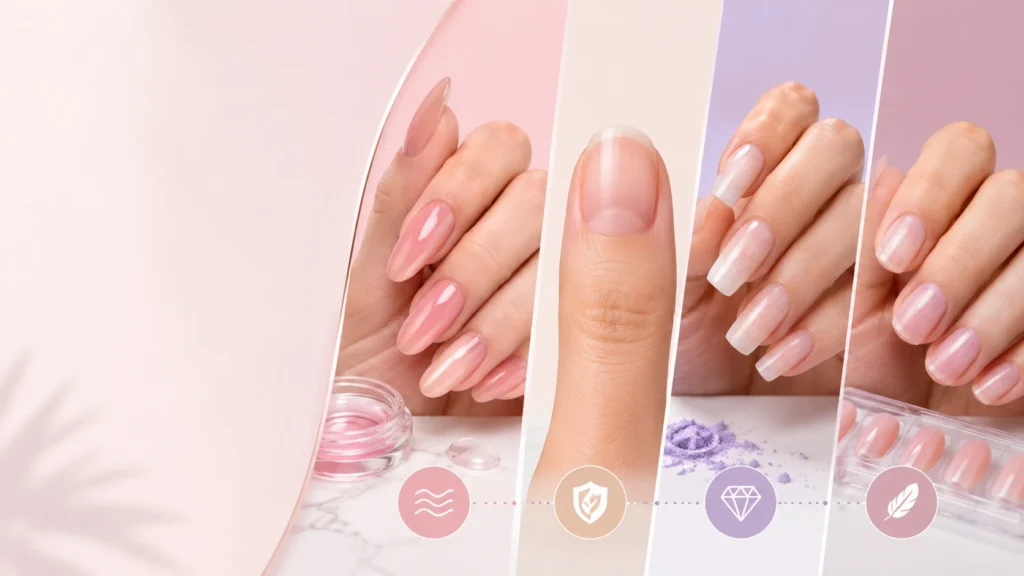
The Anatomy of Artificial Nails: How Each System Works
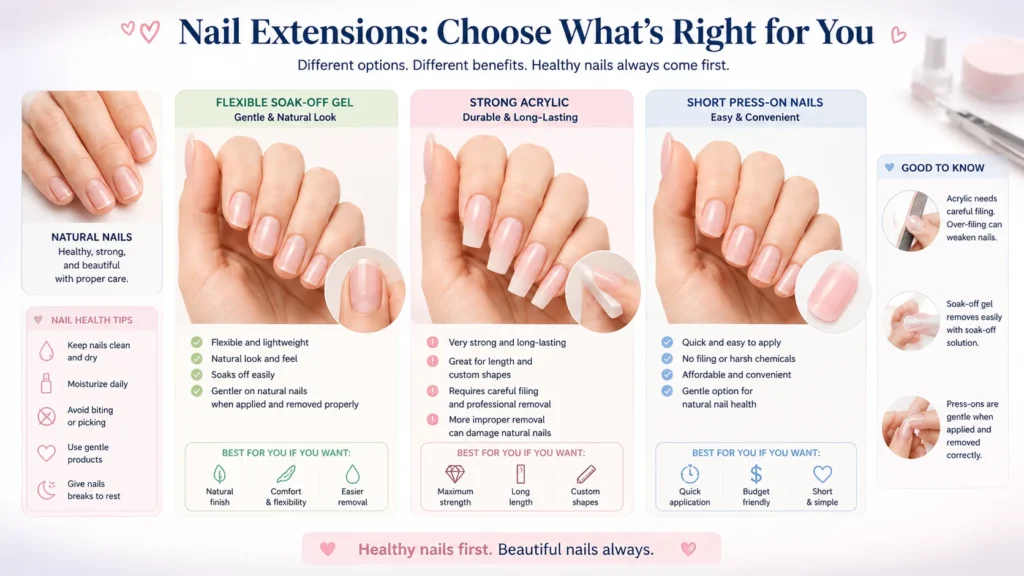
To evaluate safety, it helps to understand how these three primary cosmetic systems interact with your natural nail plate.
+----------------------------------------------------------------------------
|                            ARTIFICIAL NAIL FAMILIES                               |
+----------------------------------------------------------------------------
|  PRE-FORMED ATTACHMENTS              |  SCULPTED SALON COATINGS                   |
|  (Press-On Nails)                    |  (Gel & Acrylic Systems)                   |
|                                      |                                            |
|  - Made from plastic or soft gel     |  - Applied as liquids / gels               |
|  - Bonded via surface adhesives      |  - Chemical or UV polymerization           |
|  - Removable via gentle soaking      |  - Requires filing or acetone              |
+----------------------------------------------------------------------------
1. Press-On Nails (Pre-Formed Attachments)
Modern press-ons are engineered tips made from ABS plastic or pre-cured soft gel. Rather than creating a chemical coating directly over your finger, you attach a full-coverage tip using temporary adhesive tabs or cyanoacrylate-based nail glue.
- Curing Mechanism: None required.
- Application Time: 10–15 minutes at home.
- Removal Mechanism: Soaking in warm water with oil/soap or gentle acetone dissolution.
2. Gel Extensions (Photopolymer Systems)
“Gel” is a broad term for pre-mixed acrylate oligomers and monomers that require exposure to ultraviolet (UV) or light-emitting diode (LED) radiation to initiate polymerization (hardening).
- Soak-Off Soft Gel / BIAB (Builder in a Bottle): Formulated with lower cross-linking density, allowing acetone to penetrate and dissolve the product during removal.
- Hard Gel Extensions: Highly cross-linked photopolymers used to build dramatic structure. Hard gel cannot be dissolved by acetone and must be mechanically filed off the natural nail plate.
Most of the high-shine salon finishes trending right now including cat-eye, velvet and magnetic effects are built on gel systems, which is why gel dominates the extension market despite requiring lamp curing.
3. Acrylic Extensions (Powder & Liquid Systems)
Acrylic extensions use a two-part cold-curing system: a liquid monomer (typically ethyl methacrylate or EMA) mixed at the brush tip with a powdered polymer (poly-methyl methacrylate or PMMA).
- Curing Mechanism: Chemical self-curing upon exposure to air (no lamp required).
- Application Time: 60–90+ minutes in a salon setting.
- Removal Mechanism: Prolonged acetone soaking accompanied by structural scraping or e-file reduction.
Side-by-Side Safety Comparison
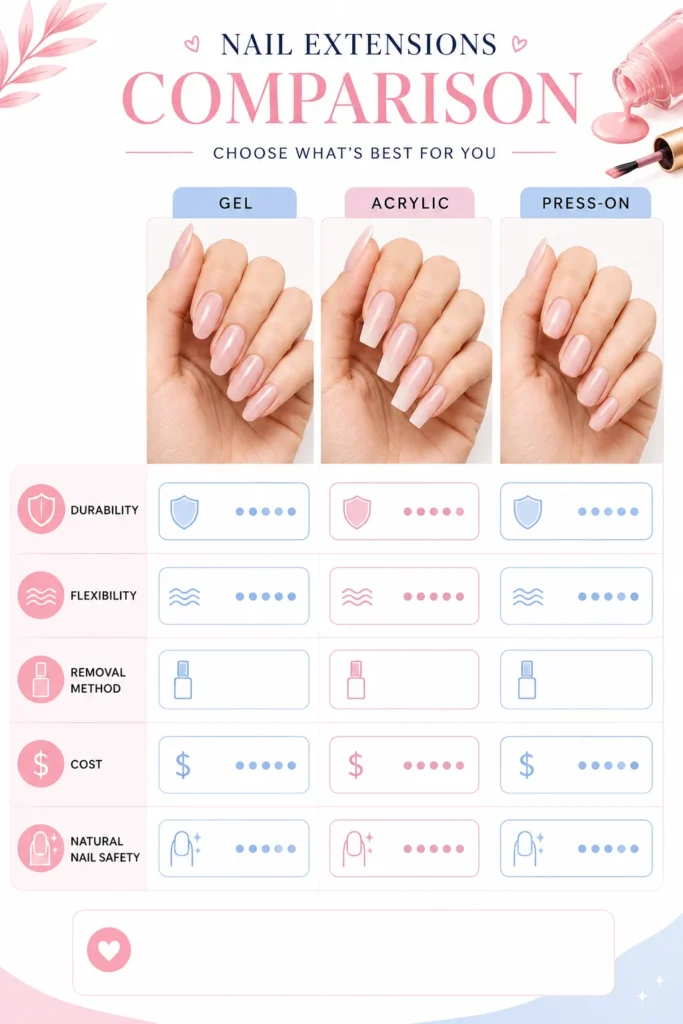
The following matrix summarizes the safety factors, risks, and performance metrics across all three systems:
| Feature | Press-On Nails | Gel Extensions (Soak-Off) | Acrylic Extensions |
|---|---|---|---|
| Primary Safety Level | Highest Safety (Lowest systemic risk) | Moderate Safety (Gentle when soaked) | Lowest Safety (Highest mechanical stress) |
| Nail Plate Surface Prep | Minimal (Gentle alcohol wipe / light buff) | Moderate (Surface shine removal required) | Heavy (Surface roughening/dehydration) |
| UV Radiation Exposure | Zero | Requires UV/LED lamp curing | Zero (Unless gel topcoat is added) |
| Chemical Sensitization Risk | Low (Concentrated to glue site) | Moderate to High (Uncured liquid acrylates) | High (Monomer fumes / skin contact) |
| Typical Wear Duration | 2–7 days (Tabs) / 2–3 weeks (Glue) | 2–3 weeks | 3–4 weeks (Requires fills every 2–3 weeks) |
| Primary Failure / Damage Risk | Prying or ripping off dry nails | Peeling product; over-filing during removal | Mechanical trauma; heavy filing; trapped moisture |
| Removal Method | Warm water, soap, and cuticle oil soak | Pure acetone soak-off + gentle scraping | Acetone soak-off + extensive filing |
Where the Damage Really Happens
Dermatologists and cosmetic chemists agree that nail damage rarely stems from the inert hardened plastic sitting on your finger. Instead, damage occurs through three distinct mechanisms:
                          PRIMARY CAUSES OF NAIL DAMAGE
                                       |
         +-----------------------------+-----------------------------+
         |                             |                             |
         v                             v                             v
  MECHANICAL TRAUMA             CHEMICAL EXPOSURE             BIOLOGICAL RISKS
  (Over-filing & Prying)       (Uncured Acrylates & Acetone)  (Trapped Moisture & Bacteria)
1. Mechanical Stress & Over-Filing
- Surface Roughening: To make acrylic or hard gel adhere, technicians often file away the top layers of dorsal keratin. Repeated filing over time thins the nail plate, causing soft, painful, or red “fire rings.”
- Prying & Peeling: Peeling off a gel polish coat or pulling off a glued press-on removes delicate layers of living keratin along with the adhesive. This leads to onychoschizia (peeling and splitting of the nail plate).
- Leverage Trauma: Long, rigid extensions act as levers. If you strike a hard surface, a rigid acrylic nail will not flex; instead, it can pull away from the underlying nail bed, causing painful onycholysis (separation of the nail plate from the bed).
Aggressive filing and cuticle work are also a leading cause of the chalky white spots and bands that show up on nails weeks after an appointment—the damage happens at the matrix, but you only see it once the nail has grown out.
2. Chemical Exposure & Sensitization
- Acrylate Allergies: Uncured gel resins or liquid acrylic monomers contain small molecules that easily penetrate the skin barrier. Repeated skin contact can trigger Allergic Contact Dermatitis (ACD). Once developed, an acrylate allergy is lifelong and can complicate future medical and dental procedures, as similar materials are used in dental fillings and joint prosthetics.
- Fume Exposure: The strong liquid monomer smell associated with traditional acrylic application stems from volatile organic compounds (VOCs). Without proper salon ventilation, these fumes can irritate the respiratory tract and skin.
3. UV Radiation
Gel systems require UV light (typically in the 365–405 nm spectrum) to cure. While the radiation dosage from a single manicure is low, frequent exposure over years can contribute to cumulative photo-aging on the backs of the hands and carries a small theoretical skin cancer risk.
       HEALTHY NAIL BED                       LIFTED EXTENSION RISK
 +-----------------------+               +-------------------------------+
 |  Intact Nail Plate    |               |  Lifted Artificial Product    |
 |  ===================  |               |  =================== \        |
 |  Adhered Nail Bed     |               |  [Trapped Moisture / Bacteria]|
 |                       |               |  Adhered Nail Bed             |
 +-----------------------+               +-------------------------------+
4. Trapped Moisture & Bacterial Infiltration
When an extension lifts at the edge but remains glued at the tip, an enclosed pocket is created. Washing hands or showering traps water inside this gap, creating an ideal environment for bacteria like Pseudomonas aeruginosa to thrive, leading to a dark green discoloration often called “green nail syndrome.”
How to Minimize Risk for Each System
The American Academy of Dermatology publishes a practical set of tips for reducing artificial nail damage that align closely with the habits below.
Safer Press-On Habits
- Never Force Removal: Soak hands in warm water mixed with dish soap and cuticle oil for 10–15 minutes. The oil breaks down the adhesive seal naturally.
- Prioritize Adhesive Tabs: For single-event wear, use sticky tabs rather than nail glue. Tabs leave the natural nail untouched.
- Check the Fit: Select tips that cover your nail bed from sidewall to sidewall without pressing into the lateral nail folds. Forcing a tip that is too small places constant pressure on the nail structure.
Safer Gel Habits
- Request Soak-Off Formulas: Ask your technician for soak-off soft gel or builder gel (BIAB) rather than traditional hard gel to ensure the product can be removed without e-filing.
- Protect Against UV Light: Apply a broad-spectrum SPF 30+ sunscreen to your hands 20 minutes before your appointment, or wear fingerless UV-protection gloves during light-curing steps. The AAD’s guidance on keeping nails healthy through gel manicures covers this in more detail.
- Stop Peeling: If a corner of your gel polish lifts, do not pick at it. Seal it with clear topcoat or book a proper fix with your salon instead.
Safer Acrylic Habits
- Choose Licensed, Ventilated Salons: Ensure your salon uses adequate local exhaust ventilation and avoids non-FDA-approved industrial monomers like Methyl Methacrylate (MMA). Look for Ethyl Methacrylate (EMA) formulations, and pick a salon with proper nail hygiene and grooming standards rather than the cheapest chair available.
- Keep Extensions Moderate in Length: Shorter extensions reduce leverage forces on the natural nail bed during everyday tasks.
- Insist on Manual Prep: Politely ask your technician to avoid heavy electrical filing directly on your bare natural nail plate.
Which Extension Should You Choose?
                               SELECTION FLOWCHART
                                        |
         +------------------------------+------------------------------+
         |                              |                              |
         v                              v                              v
  OCCASIONAL WEAR              BALANCE OF DURABILITY          MAXIMUM STRENGTH
  & LOWEST RISK                & FLEXIBILITY                  & DRAMATIC LENGTH
         |                              |                              |
         v                              v                              v
  RECOMMENDATION:              RECOMMENDATION:                RECOMMENDATION:
  Press-On Nails               Soak-Off Gel / BIAB            Acrylic Extensions
(With Adhesive Tabs/Glue) (With UV Sunscreen/Gloves) (With Gentle File Prep)- Safest Overall for Occasional Wear: Short Press-On Nails Because press-ons do not require UV lamps, heavy filing, or liquid monomer chemicals, they pose the lowest overall risk to natural nail health—provided you soak them off gently without prying.
- Safest Professional Salon System: Soak-Off Soft Gel / BIAB If you want a longer-lasting salon manicure, soak-off gels provide flex and give under impact, reducing structural stress on the natural nail bed.
- Most Durable (Highest Maintenance): Acrylic Extensions Acrylics remain unmatched for structural strength and extreme lengths, but they demand rigorous care, gentle application, and professional maintenance to avoid long-term nail thinning.
When to Avoid Artificial Extensions Entirely
Do not apply any artificial extensions or glues if your natural nails demonstrate any of the following warning signs:
- Separation (Onycholysis): The nail plate is lifting away from the pink nail bed.
- Active Discoloration: Green, dark yellow, or black patches under the nail plate.
- Inflammation: Redness, swelling, throbbing, or pus along the cuticles or sidewalls.
- Severe Structural Weakness: Extremely thin, bleeding, or cracked nail beds.
These are clinical problems, not cosmetic ones—understanding the difference between a spa, a salon and a clinic helps you go to the right place instead of covering the issue with another set.
If you experience persistent inflammation, pain, or discoloration beneath your nails, consult a board-certified dermatologist for a clinical evaluation.
Gel vs. A crylic vs. Press-On?
Are press-on nails really damage-free?
When applied to clean nails and removed properly through soaking in warm water and oil, press-on nails cause minimal to no structural damage. Damage only occurs if press-ons are forcibly ripped off dry nail beds, which strips away the outer layers of natural keratin.
Does UV light from gel lamps cause skin damage?
Gel curing lamps emit UVA radiation to harden photopolymer formulas. While the cumulative exposure from occasional manicures is relatively low, dermatologists advise applying broad-spectrum SPF 30+ sunscreen to your hands or wearing fingerless UV-protective gloves during appointments to minimize photo-aging risks.
Why do my natural nails feel thin and soft after removing acrylics?
Nail plates are made of compacted keratin that hardens when exposed to air. When covered by an airtight acrylic coating for weeks, moisture becomes trapped, temporarily softening the keratin. Furthermore, if the nail plate was thinned with an electric file during application, the nail will remain thin until new growth emerges from the matrix (which takes 4 to 6 months).
What is BIAB, and is it safer than traditional extensions?
BIAB stands for Builder in a Bottle, a thick soak-off builder gel formula. It is generally considered safer than hard gel or traditional acrylics because it creates a flexible, protective overlay directly over the natural nail plate and can be dissolved with acetone without aggressive e-filing.
Can I get an allergic reaction to nail glue or gel?
Yes. Both nail glues and gel polishes contain acrylates and methacrylates, which are known potential allergens. If uncured gel or glue touches the surrounding skin repeatedly, it can trigger an allergic contact dermatitis characterized by redness, swelling, burning, or small blisters around the fingertips.