Picking a new hair colour can feel like a gamble. A shade that looks stunning on a celebrity or in a salon lookbook can fall completely flat once it’s on you — and the reason usually has nothing to do with the colour itself. It’s about your skin’s undertone.
The right hair colour works with your skin tone to brighten your complexion, make your eyes pop, and look effortless. The wrong one can wash you out, emphasise dullness, or make your skin look uneven — no matter how trendy the shade is.
In this guide, you’ll learn how to identify your skin tone in under two minutes, the best hair colours for warm, cool, neutral, and olive skin tones (with a special focus on shades that suit Indian skin), the biggest hair colour trends for 2026, what hair colouring actually costs in India by salon tier, why professional application matters, and how to keep your colour looking salon-fresh for longer.
Quick answer: If you have a warm undertone, look for golden, honey, copper, and caramel-based shades. If you have a cool undertone, ash brown, platinum, burgundy, and blue-black tones suit you best. If you have a neutral or olive undertone the most common among Indian skin tones you’re in luck, because you can wear almost any shade, with chocolate brown, mahogany, and soft balayage being especially flattering.
Table of Contents
How to Find Your Skin Tone (Warm, Cool, or Neutral)
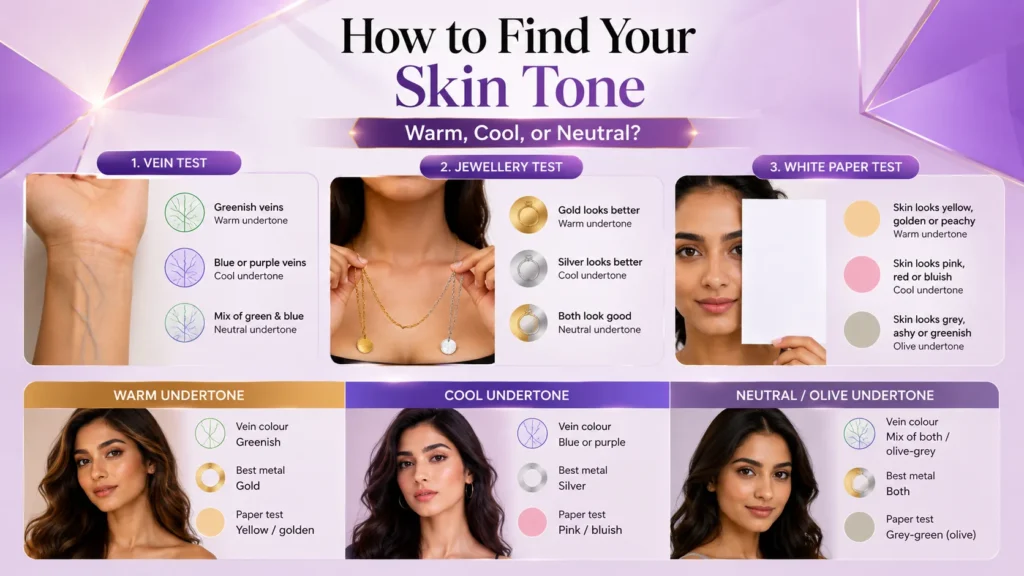
Before choosing a colour, you need to know your undertone which is different from how light or dark your skin is. Your undertone is the subtle hue beneath your skin’s surface, and it stays the same regardless of a tan or sun exposure. Here are three simple tests you can do at home right now.
1. The Vein Test
Look at the veins on the inside of your wrist in natural light.
- Greenish veins → you likely have a warm undertone
- Blue or purple veins → you likely have a cool undertone
- A mix of green and blue → you likely have a neutral undertone
2. The Jewellery Test
Hold a piece of gold jewellery and a piece of silver jewellery against your skin.
- If gold makes your skin look more radiant → warm undertone
- If silver looks more flattering → cool undertone
- If both look equally good → neutral undertone
3. The White Paper Test
Hold a plain white sheet of paper next to your face in daylight and look at how your skin reacts.
- Skin appears yellow, golden, or peachy → warm undertone
- Skin appears pink, red, or bluish → cool undertone
- Skin appears slightly grey, ashy, or greenish → you likely have an olive undertone, a common variation in Indian skin that leans neutral-to-cool with a green-grey cast
| Test | Warm Undertone | Cool Undertone | Neutral / Olive Undertone |
|---|---|---|---|
| Vein colour | Greenish | Blue or purple | Mix of both / olive-grey |
| Best metal | Gold | Silver | Both |
| Paper test | Yellow / golden | Pink / bluish | Grey-green (olive) |
Best Hair Colours for Warm Skin Tones
If you have a warm undertone, shades with golden, honey, or red bases will make your complexion glow. These colours echo your skin’s natural warmth instead of fighting it.
- Golden brown – a rich, all-purpose shade that adds dimension without looking flat
- Honey blonde – warms up the face and works beautifully with highlights
- Caramel – soft, sun-kissed, and low-maintenance as it grows out
- Copper and auburn – bold, vibrant, and especially striking against warm, deeper skin tones
- Chestnut brown – a warm-neutral brown that suits most warm-toned Indian skin
Shades to use with caution: very ashy or platinum tones can sometimes mute warm skin and create an uneven, greyish look against the complexion. If you love these tones, ask your colourist about a “warm ash” compromise.
Best Hair Colours for Cool Skin Tones
Cool undertones pair best with shades that have blue, violet, or true neutral bases. These colours create contrast against the skin in a flattering way rather than competing with warmth that isn’t there.
- Ash brown – a cool, muted brown that softens the face
- Cool / platinum blonde – high-impact and best suited to fair, cool-toned skin
- Burgundy and wine – adds richness without warmth, beautiful for deeper cool skin tones
- Blue-black – classic, glossy, and one of the most universally flattering shades for cool undertones
- Mocha – a cool-toned brown with just a hint of grey
Shades to use with caution: very golden, orange, or copper-heavy tones can sometimes look slightly mismatched against cool-toned skin, occasionally bringing out redness.
Best Hair Colours for Neutral and Olive Skin Tones
Here’s the good news: if your undertone is neutral or olive — which describes a large share of Indian skin tones — you have the most flexibility of all. Neutral undertones don’t clash with warm or cool shades, which means almost any colour can be made to work with the right placement and balance.
That said, a few shades consistently look exceptional on olive and neutral skin:
- Chocolate brown – deep, glossy, and universally flattering
- Mahogany – a brown with a subtle red undertone that adds warmth without overpowering olive skin
- Soft balayage or babylights – multi-tonal colour that mimics how hair naturally lightens in sunlight, adding dimension without a harsh line of demarcation
- Caramel highlights on a brown base – brightens the face while keeping maintenance manageable
If you have olive skin and want to go lighter or more dramatic (think copper, burgundy, or ash tones), it’s worth doing a consultation first — olive undertones can sometimes pull green or grey with certain cool, ashy shades, and a skilled colourist will know how to balance the formula.
Trending Hair Colours in India for 2026
Hair colour trends in 2026 are leaning toward low-maintenance, multi-dimensional colour that grows out gracefully — perfect if you don’t want to be back in the salon chair every four weeks. Here’s what’s having a moment:
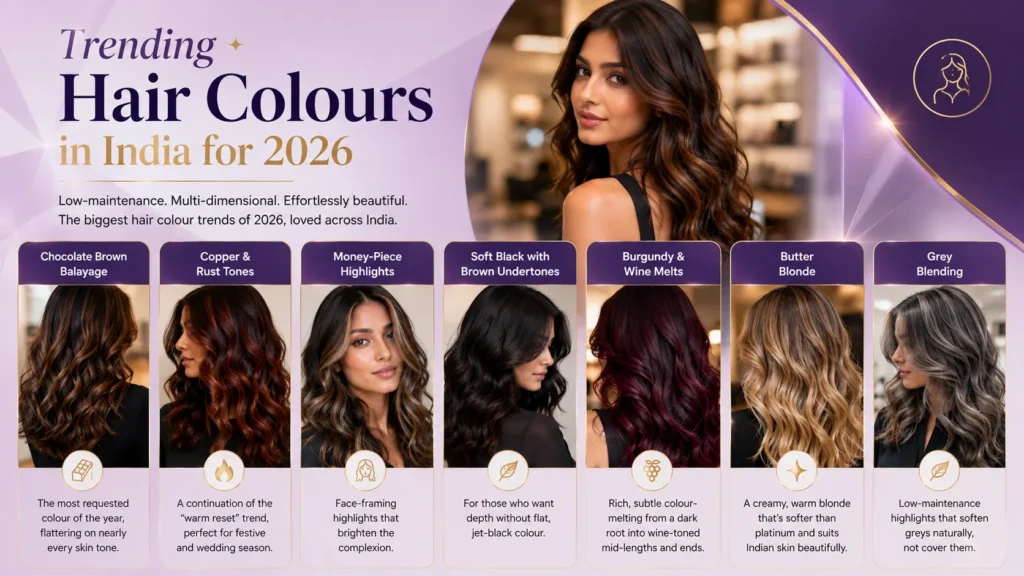
- Chocolate brown balayage – the most requested colour of the year, flattering on nearly every skin tone
- Copper and rust tones – a continuation of the “warm reset” trend, especially popular for festive and wedding season
- Money-piece highlights – face-framing highlights that brighten the complexion without a full-head commitment
- Soft black with brown undertones – for those who want depth without flat, jet-black colour
- Burgundy and wine melts – rich, subtle colour-melting from a darker root into a wine-toned mid-length and ends
- Butter blonde – a creamy, warm blonde that’s softer than platinum and suits Indian skin better than icy tones
- Grey blending – low-maintenance highlight techniques designed to soften greys naturally rather than fully covering them
Hair Colour Cost in India: What to Expect
Hair colouring prices in India vary significantly depending on the salon’s tier, the product line used (ammonia-based vs ammonia-free/organic), your hair length, and the technique. Here’s a general breakdown to help you budget:
| Service | Budget Salon | Mid-Range Salon | Premium / Luxury Salon |
|---|---|---|---|
| Global hair colour | ₹800 – ₹2,000 | ₹2,000 – ₹4,500 | ₹4,500 – ₹10,000+ |
| Highlights / balayage | ₹1,500 – ₹3,500 | ₹3,500 – ₹7,000 | ₹7,000 – ₹15,000+ |
| Root touch-up | ₹500 – ₹1,200 | ₹1,200 – ₹2,500 | ₹2,500 – ₹5,000 |
| Ammonia-free / organic colour (add-on) | ₹500 – ₹1,000 extra | ₹1,000 – ₹2,000 extra | ₹2,000 – ₹4,000 extra |
Prices vary by city, salon brand, hair length and thickness, and current promotions — always confirm the final quote during your consultation.
A few cost-saving tips: ask whether root touch-ups are priced separately from a full global colour (they’re significantly cheaper and needed more often), check if the salon includes a post-colour conditioning treatment in the price, and ask about loyalty packages if you plan to colour your hair regularly — many salons on Glox offer bundled colour + maintenance packages.
At-Home vs Salon Colouring: Why Professional Application Matters
Box dye is tempting — it’s cheap, convenient, and you can do it on a Sunday afternoon. But hair colouring is genuinely one of the few beauty treatments where the gap between DIY and professional results is enormous, for a few key reasons:
- One-size-fits-all formulas don’t account for your existing hair colour, porosity, or grey percentage, which is why box dye results often look noticeably different from the shade on the packaging.
- No patch test means no warning for allergic reactions. Salons are trained to perform patch tests 24-48 hours before colouring to check for sensitivity to PPD and other common allergens.
- Uneven application is the #1 reason for colour correction visits. Hard-to-reach areas (back of the head, roots vs. ends) are easy to miss at home, leading to patchy, uneven colour.
- Over-processing damage from incorrect timing or mixing ratios can leave hair brittle, and fixing damaged, over-processed hair often costs more — in money and hair health — than the original salon visit would have.
- Professional colourists formulate for your undertone, which is the entire premise of this guide. A salon consultation factors in your skin tone, your hair’s current condition, and your maintenance preferences before mixing a single drop of colour.
If budget is the main concern, ask your salon about root-touch-up-only services between full colour appointments — it’s a fraction of the cost of a global colour and keeps your look fresh.
How to Maintain Coloured Hair
Colour-treated hair needs a slightly different care routine to stay vibrant and healthy. Here’s what actually makes a difference:
- Switch to a sulfate-free shampoo. Sulfates strip colour molecules and cause fading, especially in reds, coppers, and vibrant tones.
- Wash with cool or lukewarm water. Hot water opens the hair cuticle and accelerates colour fade.
- Use a UV-protectant spray. Sun exposure is one of the biggest (and most overlooked) causes of colour fading, particularly for warm and red tones.
- Apply a heat protectant before styling. Coloured hair is more porous and prone to heat damage.
- Book a deep-conditioning hair spa every 3-4 weeks. This restores moisture and shine, and significantly extends the life of your colour.
- Stick to a touch-up schedule. Roots typically need attention every 4-6 weeks, while a full global colour refresh is usually recommended every 8-10 weeks, depending on how fast your hair grows and how much grey you’re covering.
Frequently Asked Questions
How long does hair colour last?
Hair colour typically lasts 4-8 weeks before fading or root regrowth becomes noticeable, depending on the type of colour (permanent vs. semi-permanent), your hair’s porosity, and how well you maintain it with sulfate-free products and reduced heat styling.
Does hair colouring damage hair?
Hair colouring can cause some dryness and reduced elasticity because the colouring process opens the hair cuticle, but professional application with the right formulation, processing time, and post-colour care (such as bond-building treatments) minimises damage significantly compared to at-home colouring.
Can I colour over previously coloured hair?
Yes, but it requires care — colouring over previously coloured hair, especially if you’re changing shades dramatically (like going from dark to light), often requires a strand test and sometimes a colour-correction process to achieve an even result, which is best done by a professional.
What is the best hair colour for grey coverage?
The best hair colours for grey coverage are typically warm to neutral browns and soft blacks, as they blend naturally with the white/grey hair underneath; many people also choose grey-blending highlight techniques, which require less frequent touch-ups than full grey coverage.
Which hair colour suits Indian skin tones best?
Most Indian skin tones fall in the neutral-to-olive range, which means chocolate brown, mahogany, soft balayage, and caramel-highlighted browns are universally flattering, while warmer undertones suit golden browns and coppers, and cooler undertones suit ash browns and burgundy.
How much does hair colour cost in India?
Hair colour costs in India typically range from ₹800 for a basic global colour at a budget salon to ₹10,000 or more for premium balayage or colour correction at a luxury salon, with root touch-ups generally costing 30-50% less than a full global colour.
Ready to Find Your Shade?
Choosing a hair colour doesn’t have to be a guessing game. Use Glox’s AI-powered style assistant to get personalised colour suggestions based on your skin tone and hair type, or book a consultation with a verified colour expert near you — transparent pricing, real reviews, and easy booking, all in one app.