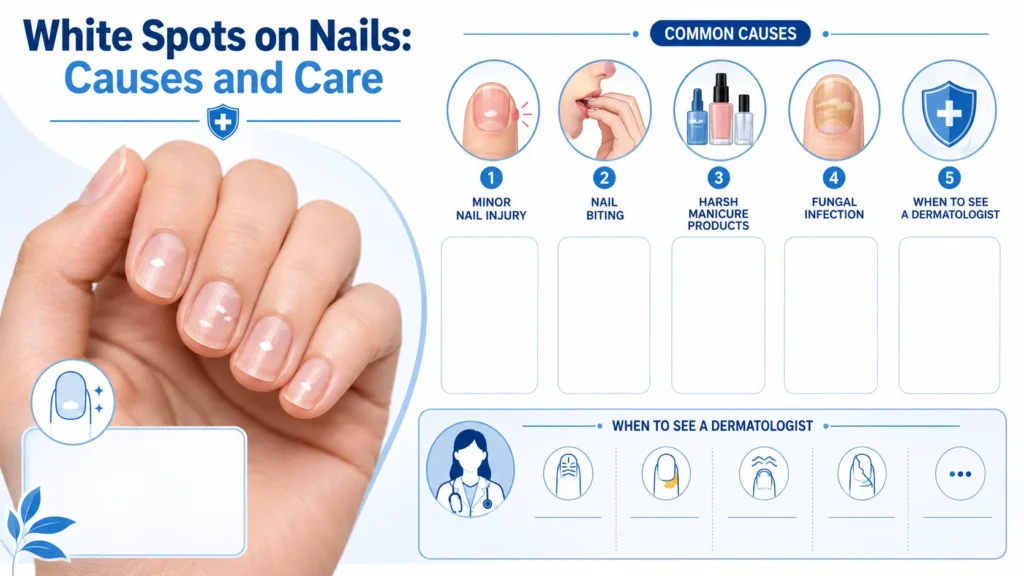
It is a scenario almost everyone encounters at least once: you look down at your hands and notice a small, milk-white dot or band sitting right in the middle of your fingernail.
The most common myth is that a lack of calcium or a late-night craving for dairy causes it. Another popular belief is that it means good fortune is on the way.
The medical reality is far more grounded. Known clinically as leukonychia, these white marks are extremely common, usually harmless, and often the footprint of a minor injury that happened weeks ago.
However, because nail changes can occasionally reflect underlying skin conditions, fungal infections, or internal health shifts, knowing what to look for is essential.
Table of Contents
What Is Leukonychia?
Leukonychia (derived from the Greek words leuko meaning “white” and onyx meaning “nail”) is the medical term for any condition where white discoloration appears on the fingernails or toenails.
To understand why these spots form, it helps to look at how your nail is constructed:
+-------------------------------------------------------------------------+
|                                                                         |
|   [ NAIL MATRIX ]  -------->  [ NAIL BED ]  -------->  [ NAIL PLATE ]   |
|  (Where growth begins        (Skin underneath          (Hard translucent|
|    under the cuticle)          the nail plate)            keratin layer)|
|                                                                         |
+-------------------------------------------------------------------------+
Your nail plate is made of dozens of tightly compacted, translucent layers of a hard protein called keratin. Because the plate itself is clear, you normally see the pinkish, blood-vessel-rich nail bed underneath.
When something disrupts the way these keratin fibers lay down—or when air becomes trapped between the layers—the light reflects differently, making that specific area appear opaque and white.
The 3 Clinical Types of Leukonychia
Dermatologists classify white nails into three distinct anatomical categories based on where the problem originates:
                            TYPES OF LEUKONYCHIA
                                     |
         +---------------------------+---------------------------+
         |                           |                           |
         v                           v                           v
  TRUE LEUKONYCHIA          APPARENT LEUKONYCHIA        PSEUDOLEUKONYCHIA
  Origin: Nail Matrix       Origin: Nail Bed (Under)    Origin: Nail Surface
  Does NOT fade with        Fades or vanishes when      Surface texture changes;
pressure; grows out. pressure is applied. caused by external factors.- True Leukonychia: The white discoloration originates within the nail matrix (where the nail is created). As the matrix grows, the damaged, white keratin moves outward toward the fingertip. Key diagnostic test: If you press down on the nail, the white mark does not disappear.
- Apparent Leukonychia: The nail plate itself is completely clear, but the nail bed underneath is compromised or swollen, making the nail look white. Key diagnostic test: When you press firmly on the nail, the white appearance fades or temporarily vanishes because you are squeezing blood out of the underlying tissue.
- Pseudoleukonychia: The white appearance is caused by external agents affecting the very top surface of the nail plate, such as a superficial fungal infection or chemical erosion from artificial nails.
DermNet’s clinical reference on white nail (leukonychia) covers the full morphological and anatomical classification in more depth.
Identifying the Pattern: What Do Your White Spots Look Like?
Not all white spots are created equal. The exact shape, distribution, and texture of the discoloration provide major clues about its underlying cause.
| Visual Pattern | Medical Name | Most Likely Cause |
|---|---|---|
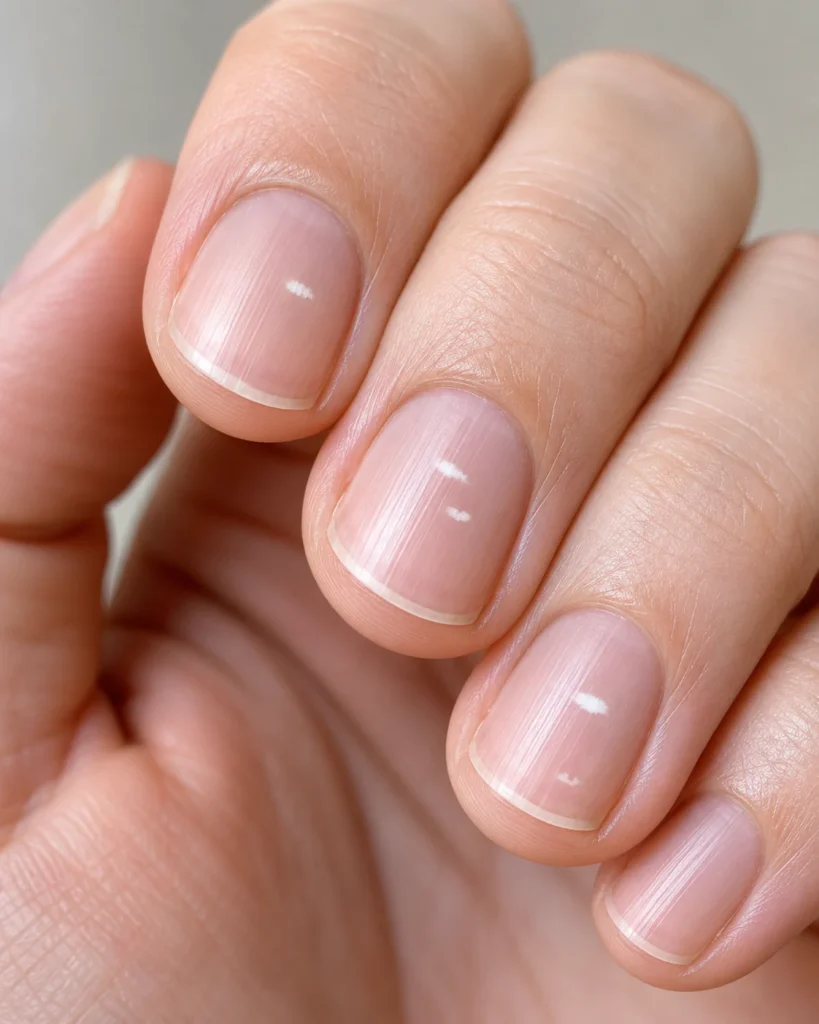
| Isolated tiny white dots | Punctate Leukonychia | Minor physical trauma, nail biting |
| Horizontal white bands across the nail | Striate / Transverse Leukonychia | Aggressive manicures, systemic stress, Mees’ / Muehrcke’s lines |
| Vertical white stripes | Longitudinal Leukonychia | Darier disease, localized trauma |
| Powdery, rough, white patches on surface | Superficial White Onychomycosis | Fungal infection (Onychomycosis) or severe chemical dehydration |
| Entire nail turns white | Total Leukonychia | Genetic condition, severe systemic illness, or advanced fungus |
The 6 Most Common Causes of White Spots
1. Physical Trauma or Nail Injury (The #1 Cause)
By far, minor matrix trauma accounts for over 80% of all punctate (dotted) leukonychia cases. Because fingernails grow at an average rate of 3.47 millimeters per month (and toenails grow even slower), an injury to the root of your nail may take 4 to 6 weeks to actually become visible above the cuticle.
Common Culprits:
- Accidental impacts (bumping your hand against a desk or dropping an object).
- Habitual nail biting or cuticle picking.
- Using your nails as tools to pry open cans or scrapers.
- Wearing tight, narrow-toed footwear (a leading cause of white spots on toenails).
- Forceful use of metal cuticle pushers or drill bits during manicures.
Why you don’t remember injuring it: By the time you notice the white dot halfway up your fingernail, the impact that caused it happened over a month ago.
2. Harsh Chemicals, Manicures, and Allergies
Repeated exposure to aggressive nail cosmetics can weaken the keratin bonds of the nail plate, causing surface flaking and deep discoloration (pseudoleukonychia).
- Acrylates and Glues: Chemicals found in dip powders, gel polishes, and acrylic extensions can provoke an allergic contact dermatitis or direct toxic irritation to the nail bed.
- Aggressive Removal: Peeling off gel polish or filing down artificial nails strips away the top protective layers of natural keratin, leaving chalky white patches behind.
- Acetone Overuse: Frequent immersion in 100% acetone dehydrates the nail plate severely, creating brittle, white, powdery surface damage.
If you regularly wear gel, magnetic and cat-eye nail finishes, build in recovery gaps between sets rather than doing back-to-back applications.
3. Fungal Infections (Superficial White Onychomycosis)
While most nail fungi cause thick, yellow, or crumbling nails, a specific subtype called Superficial White Onychomycosis (SWO) behaves differently.
Organisms (most commonly Trichophyton mentagrophytes) attack the uppermost layer of the nail plate directly. It starts as small, chalky-white patches on the surface. If left untreated, these patches spread to cover the entire nail, leaving it rough, dry, and powdery.
       HEALTHY NAIL                   FUNGAL INFECTION (SWO)
 +-----------------------+          +-----------------------+
 | Smooth surface        |          | Rough, powdery surface|
 | Translucent plate     |          | Spreading white mask  |
 | Intact cuticle        |          | Flaking / crumbling   |
 +-----------------------+          +-----------------------+
4. Nutritional Deficiencies: Myth vs. Reality
There is a widespread misconception that every white spot means a severe lack of calcium. Clinical dermatological studies show that calcium deficiency is rarely the cause of isolated white spots.
However, genuine nutritional deficiencies can impact nail architecture:
- Zinc Deficiency: Essential for cellular division and protein synthesis. A severe lack of zinc can cause white horizontal bands or generalized brittleness.
- Iron Deficiency (Anemia): More frequently causes koilonychia (spoon-shaped nails), but can occasionally lead to pale, whitened nail beds (apparent leukonychia).
- Severe Protein Malnutrition: Lower levels of plasma albumin (hypoalbuminemia) can cause classic white horizontal lines across all nails (known as Muehrcke’s lines).
5. Inflammatory Skin Conditions
Systemic skin diseases that disturb skin cell production often affect the nail matrix as well:
- Nail Psoriasis: Causes “salmon patches,” deep surface pitting, nail crumbling, and leukonychia.
- Eczema / Atopic Dermatitis: Severe hand eczema around the tips of the fingers can inflame the cuticle and underlying matrix, leading to irregular white ridging.
- Alopecia Areata: An autoimmune condition primarily known for hair loss that can also cause rough, sandpaper-like, whitened nails (trachyonychia).
6. Systemic Illnesses, Medications, and Heavy Metals
In rare circumstances, distinct patterns of white nails serve as a diagnostic window into systemic health issues:
- Terry’s Nails: Almost the entire nail plate looks ground-glass white, with a thin dark pink band at the very tip. This pattern is linked to liver cirrhosis, congestive heart failure, or type 2 diabetes.
- Half-and-Half Nails (Lindsay’s Nails): The proximal half (closest to the cuticle) is stark white, while the distal half (tip) is pinkish-brown. This is commonly observed in chronic kidney disease.
- Mees’ Lines: True white transverse lines running parallel across multiple nails, classically associated with heavy metal poisoning (such as arsenic or lead), or systemic exposure to certain chemotherapy agents.
- Systemic Medications: Antibiotics containing sulfonamides, retinoids (like isotretinoin), and biological immune suppressants can occasionally cause leukonychia as a secondary side effect.
Home Care vs. Medical Treatment: How to Fix Them
Treatment for white spots depends entirely on what caused them in the first place.
                               DIAGNOSIS & ACTION PLAN
                                          |
         +--------------------------------+--------------------------------+
         |                                |                                |
         v                                v                                v
   MATRIX TRAUMA                  CHEMICAL / COSMETIC               FUNGAL INFECTION
 (Impact, Biting)                  IRRITATION (Polishes)              (Rough / Powdery)
         |                                |                                |
         v                                v                                v
  - No medicine required.          - Rest nails from gels/acrylics. - Consult doctor for testing.
  - Apply cuticle oil daily.       - Avoid 100% pure acetone.       - Apply prescription topical
  - Wait for nail to grow out      - Use non-toxic, 10-free          antifungal or take oral
    (4-6 months).                    polishes.                        medication (e.g., terbinafine).
If Caused by Injury or Physical Trauma
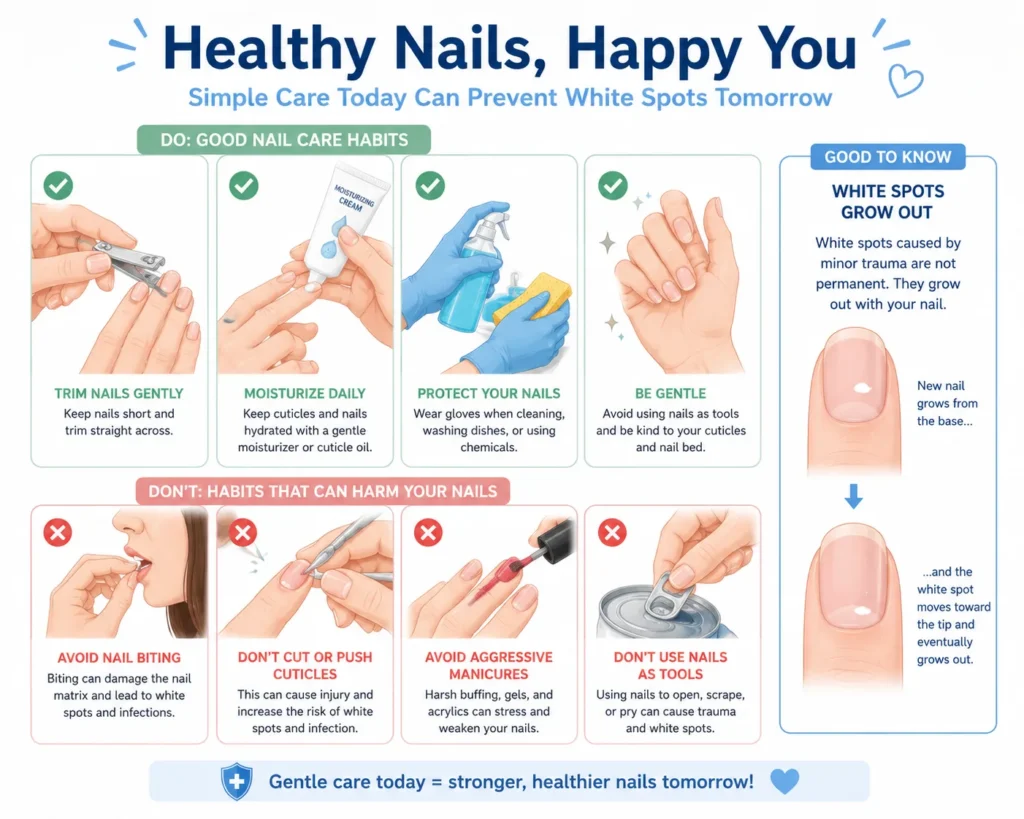
- Time and Patience: There is no magic cream or pill that accelerates the clearance of an existing true leukonychia spot. The damaged keratin must physically grow out.
- Maintain Elasticity: Keep the nail plate hydrated with jojoba oil or vitamin E oil to prevent cracking as the mark moves toward the edge.
- Trim Safely: As the white spot reaches the free edge of your finger, clip it straight across with clean clippers. Do not dig under or scrape the nail plate.
If Caused by Cosmetic Damage or Chemicals
- Enforce a “Nail Holiday”: Pause all artificial nails, gel manicures, and heavy lacquers for at least 3 to 4 weeks. When you do go back, book with a salon you’ve properly vetted instead of walking into whichever chair is free.
- Rehydrate: Apply a thick lipid-based hand cream and cuticle balsam containing ingredients like shea butter, ceramides, or hyaluronic acid twice daily.
- Switch Products: Opt for acetone-free polish removers and look for “10-free” or “13-free” non-toxic nail polishes that omit harsh solvents like formaldehyde and toluene.
If Caused by a Fungal Infection
- Skip DIY Remedies: Home applications of pure vinegar, tea tree oil, or garlic pastes may offer minor antiseptics, but rarely eradicate an established fungal infection deep within the nail plate.
- Get Tested: A healthcare provider will take a small scraping or clipping for a potassium hydroxide (KOH) preparation or fungal culture to confirm the exact organism.
- Prescription Interventions:
- Topical Antifungal Lacquers: Drugs such as ciclopirox or amorolfine applied directly to the surface (effective for early-stage superficial white onychomycosis).
- Oral Antifungals: Medications like oral terbinafine (Lamisil®) or itraconazole (Sporanox®) may be necessary if the infection has spread toward the cuticle or nail bed.
Prevention: 7 Golden Rules for Stronger, Healthy Nails
- Never Pick or Peel: Resist the urge to tear or peel off chipped gel polish or loose cuticles. Peeling strips away the protective superficial keratin layer.
- Moisturize Daily: Apply a dedicated cuticle oil (jojoba oil penetrates keratin exceptionally well) every night before sleep.
- Practice Salon Safety: Ensure your nail technician uses autoclaved metal tools, single-use files, and avoids aggressive cutting of the eponychium (cuticle). Choosing a salon with proper hygiene and grooming standards matters more for nail health than the price of the manicure.
- Wear Protective Gloves: Put on nitrile or rubber gloves when washing dishes, gardening, or handling household cleaning solutions to prevent chemical erosion.
- Wear Properly Fitted Shoes: Ensure a half-inch of space between your longest toe and the end of your shoe to avoid repeated mechanical trauma to toenails.
- Eat a Balanced Matrix-Building Diet: Focus on whole foods rich in protein, zinc (pumpkin seeds, lentils, shellfish), biotin (eggs, almonds), and iron (spinach, legumes).
- Sterilize Personal Tools: Clean your household nail clippers and glass files with 70% isopropyl alcohol after every use to prevent fungal or bacterial cross-contamination.
When Should You See a Doctor?
While the vast majority of white spots are harmless consequences of daily life, certain red flags necessitate an evaluation by a board-certified dermatologist or primary care physician.
Nail concerns sit outside what a salon can handle — this is where knowing the difference between a spa, a salon and a clinic helps you go to the right place the first time.
Seek medical evaluation if:
- Discoloration affects all 20 nails simultaneously.
- The entire nail plate has turned completely opaque or white.
- You notice horizontal white bands across multiple fingers (Mees’ / Muehrcke’s lines).
- The nail is painful, red, swollen, throbbing, or discharging fluid or pus.
- The nail plate is lifting off the skin bed (onycholysis).
- You have an underlying health condition (diabetes, kidney disease, or liver disease).
- A dark brown or black streak accompanies the white discoloration.
The American Academy of Dermatology also lists nail changes that warrant a dermatologist’s evaluation.
White Spots on Your Nails?
Does taking calcium supplements make white spots on nails disappear?
No. For most people, white spots are caused by minor physical trauma to the nail root, not a calcium deficiency. Taking unnecessary calcium supplements will not remove existing spots and can cause adverse side effects if taken in excess without medical supervision.
How long does it take for a white spot on a fingernail to grow out?
Fingernails grow at an average rate of 3.47 mm per month. Depending on where the injury occurred within the matrix, it typically takes 4 to 6 months for a white spot on a fingernail to reach the free edge and be trimmed off. Toenails grow much slower and can take 12 to 18 months to fully grow out.
Can stress or anxiety cause white spots on nails?
Stress itself does not directly change the pigment of your nail plate. However, psychological stress often triggers subconscious behavioral habits—such as nervous nail biting, cuticle picking, or pressing hard against the nails—which cause physical trauma to the matrix, resulting in leukonychia weeks later.
What is the difference between white spots from an injury and a fungal infection?
White spots from an injury are usually isolated, smooth-surfaced, non-spreading dots or lines that slowly migrate outward as the nail grows. A surface fungal infection (Superficial White Onychomycosis) usually creates rough, chalky, powdery white patches on top of the nail plate that expand and spread across the surface over time rather than moving outward.
Is leukonychia dangerous or contagious?
Traumatic or chemical leukonychia is completely harmless and not contagious. However, if the white patches are caused by a fungal infection (onychomycosis), the fungus can spread to adjacent nails, your skin (athlete’s foot), or other people through shared nail tools and damp surfaces.